
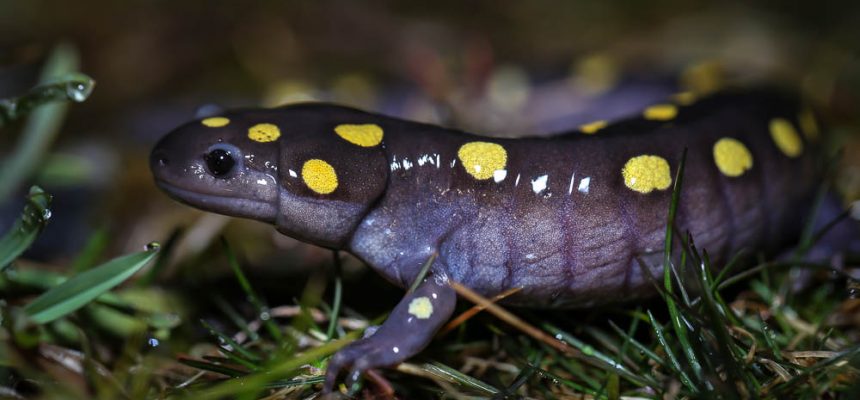
Salamander Season 2013
With big rains during the first half of April, many amphibians were assisted across roads by crossing guard volunteers.
If you were one of those volunteers, and would like to submit a report, click here.
Become a Salamander Crossing Guard
Each spring, amphibians head to the breeding pools their progenitors have used for hundreds, or perhaps thousands of years. Superimposed upon this ancient world, however, is a new world roads and cars. In areas where salamanders, frogs, and toads are forced to cross even moderately busy roads, populations of these animals are likely to disappear. Helping amphibians safely negotiate road crossings is imperative to the long-term survival of these vernal pool breeding amphibians.
We Need You!
Step #1: Sign Up for Alerts
Join the amphibian alert digital hotline by sending an email to Patti. Let her know where you live and she can advise on sites where you are needed.
Step #2: Choose a Site
Open the Google Map and locate the site(s) nearest you.
Step #3: Learn What to Do
Download the Become a Crossing Guard brochure. This provides the basic information you will need.
Step #4: Crossing Night Sign-Up
Because site coverage can be spotty, we have developed a new system that we hope will save more spotteds. Once you receive a BEEC hotline alert and plan to help, let us all know where you plan to be and when you plan to be there. Go to the sign-up sheet that is linked to the site on the Google Map. This will only work if most of us use it! This can also make the job of coordinating sites easier.
Step #5: Submit Your Data Electronically
Report what you find. Keep track of the species and numbers of each that you find and report to your site coordinator. If your site has no coordinator, print out a data sheet (zip/doc) to take in the field. BEEC has data sheets printed on waterproof paper. Contact Patti if you would like some mailed to you. Send your reports to BEEC at the end of the season, or better yet, submit your data electronically here.
Safety First in 2013!
Cars pose hazards to humans as well as amphibians, as Brattleboro residents have learned over the past year, with a number of serious pedestrian/automobile accidents. Crossing guards assist salamanders on rainy and sometimes foggy nights, with a goal of keeping cars from hitting amphibians—a potentially dangerous mix. Please protect yourselves, motorists, and the amphibian crossing program by being prepared with safety gear in advance of migration nights and by following safety guidelines while you’re out there.
Safety Essentials:
1) Light colored clothing
2) Reflective vests for everyone
3) Flashing clip-on lights for everyone
4) Signs with flashing lights attached to alert drivers in advance
5) When cars approach your site, step off the roadway
6) Park your own vehicles off the road and out of the crossing zone
Brown & Roberts Hardware (Main Street, Brattleboro) is offering salamander crossing guards reflective safety vests at cost (approx. $10). Ask for the vest and the discount at the checkout counter. They also stock clip-on flashing lights for $1.49. Thank you Brown & Roberts!
Be a Better Crossing Guard!
Click here for hot tips.
Three Volunteer Categories
Site Coordinators
Amphibians are especially grateful to site coordinators! These committed individuals ensure that there will be volunteers and salamander crossing signs at their site when the amphibians need them. Coordinators are provided with signs, amphibian identification sheets, a list of volunteers, and data sheets. More coordinators are always needed. Read the Salamander Crossing Brigade Coordinator’s Handbook (pdf) to learn more. Contact Patti if you would like to coordinate a site.
Crossing Guards
These volunteers are part of the brigade at a known crossing site. They are on call throughout the season.
Free Range Crossing Guards
Many of the sites have no coordinators. Volunteers who patrol these sites are encouraged to collect data and send in reports on the numbers of amphibians. We encourage these volunteers to read the Salamander Crossing Brigade Coordinator’s Handbook (pdf). We also encourage you to get (or make your own) salamander crossing signs. These volunteers may go to different crossing sites on different nights depending on where they are needed.
Things to bring on a Salamander Crossing Night
Get ready in advance! You will NEED these things:
- Rain gear
- Reflective clothes
- Flashing clip-on light
- Bright flashlight with extra batteries (headlights are not bright enough)
Optional:
- Camera
- Spatula for dead amphibians
- Clean bucket
- Salamander Crossing signs
- Clip on flashing lights for signs and self
- Amphibian identification sheets
BEEC Salamander Crossing Supplies
Salamander crossing signs:
These signs are 2′ x 2′ corrugated plastic, and come with a wire stand. They are durable and very portable! BEEC loans these sings to site coordinators and to anyone who plans to patrol sites that have no coordinator. If you think this might be you, email Patti to arrange pick-up or delivery. We also have clip-on flashing light to attach to the signs.
Sign recommendations:
The signs attract more attention if you clip a flashing light to them.
These signs often get stolen. Don’t leave them up when no guards are on duty.
Publications
![]() |
Download Salameanderings, a newsletter devoted to salamanders (pdf).
|
Crossing Site Maps Brattleboro
Dummerston
- All Dummerston Sites
- Black Mountain
- Dummerston Sites
- East Dummerston
- East-West Road*
- Kipling Road
- Middle Road
- Rice Farm Road*
Guilford
Newfane/Williamsville
Putney
Vernon
Westminster West
*Sites with official crossing brigades.
Links
Link to the Vermont Reptile and Amphibian Atlas: http://community.middlebury.edu/~herpatlas/herp_index.htm Link to the North American Amphibian Monitoring Program: http://www.pwrc.usgs.gov/NAAMP/protocol/index.htm
